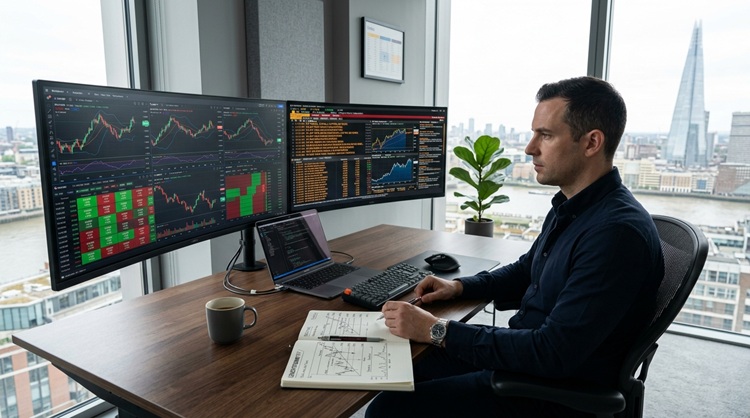
Ask someone what is forex trading, and the answer is often surprisingly brief: buying one currency while selling another. While technically correct, that explanation barely captures the scale of the market or why it attracts participants ranging from multinational corporations to individual traders.
Unlike stock exchanges that operate during specific hours, the foreign exchange market functions around the clock during the business week as financial centers move from Sydney to Tokyo, London, and New York. That continuous activity supports global commerce, international investment, tourism, and central bank operations, making currencies an essential part of the financial system rather than a niche investment product.
Its size is equally remarkable. According to the Bank for International Settlements’ 2022 Triennial Central Bank Survey, average daily turnover in the global foreign exchange market reached approximately $7.5 trillion, making it the largest financial market in the world.
Table of Contents
Every Currency Trade Has Two Sides
Unlike buying shares of a company, trading currencies always involves a pair. When traders buy EUR/USD, they are purchasing euros while simultaneously selling U.S. dollars. If they sell GBP/JPY, they are selling British pounds and buying Japanese yen.
That structure means traders are constantly evaluating one economy against another rather than asking whether a single asset is likely to rise or fall.
Economic data, interest rates, inflation, and central bank policy all influence those relative values.
Liquidity Creates Different Trading Conditions
One reason professional traders are drawn to the currency market is its exceptional liquidity. Popular pairs such as EUR/USD and USD/JPY are traded by banks, hedge funds, multinational businesses, governments, and retail participants throughout the day.
High liquidity generally contributes to tighter spreads and smoother order execution compared with many smaller financial markets. It also means major economic announcements can produce rapid price adjustments as enormous trading volumes react almost simultaneously.
More participants do not necessarily make the market easier to trade, but they do create a highly active environment.
News Matters, but Context Matters More
Imagine the U.S. releases stronger-than-expected employment data. At first glance, traders may expect the U.S. dollar to strengthen immediately. Instead, the currency briefly rises before reversing lower because investors focus on weaker wage growth within the same report, reducing expectations for future interest rate increases.
This type of reaction surprises many beginners.
Markets rarely respond to headlines alone. Traders constantly compare new information against existing expectations, making context just as important as the economic numbers themselves.
The Largest Market Rewards Preparation
Many newcomers assume the vast size of the currency market makes it impossible for individual traders to compete. Interestingly, the opposite can be true.
Retail traders are not expected to process every transaction occurring around the world. Their advantage comes from specialization. Many successful traders focus on only a few currency pairs, specific trading sessions, or recurring economic events rather than trying to monitor every market simultaneously.
Understanding what is forex trading eventually becomes less about memorizing terminology and more about recognizing how currencies respond to changing economic conditions. The market’s enormous size creates countless opportunities, but those opportunities are rarely distributed evenly across every trading session or currency pair.
Before opening your first position, spend time learning how the currencies you plan to trade typically react to economic releases, central bank decisions, and shifts in market sentiment. A deeper understanding of market behavior will usually provide more value than simply knowing how to place an order.