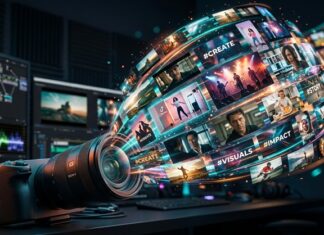
Visual content has become an essential part of digital communication. From social media posts and online advertisements to presentations, videos, and educational materials, images help people communicate ideas quickly and effectively. However, producing original visuals traditionally requires photography skills, graphic design experience, specialized software, or access to stock image libraries.
Artificial intelligence is changing this process. One of the most interesting developments in creative technology is the rise of AI picture generators, which can transform written descriptions and other inputs into unique images within seconds. These tools are making visual creation more accessible while introducing entirely new possibilities for designers, marketers, video creators, students, and everyday users.
Table of Contents
What Is an AI Picture Generator?
An AI picture generator is a software tool that uses artificial intelligence to create images based on user instructions. In many cases, users simply provide a text prompt describing what they want to see. The system interprets the description and produces an image that attempts to match it.
For example, a user might enter a prompt such as “a futuristic city surrounded by mountains at sunset.” The AI analyzes concepts such as the city, mountains, lighting, atmosphere, and visual style before generating a corresponding picture.
Modern tools can often understand much more detailed instructions. Users may specify the composition, colors, lighting conditions, camera perspective, artistic approach, background, or mood they want. The quality of the result can depend significantly on how clearly these details are communicated.
An AI picture generator can therefore function as both a creative tool and a rapid visualization system. Instead of searching through hundreds of existing images to find something close to an idea, users can describe the idea and generate a new visual around it.
How Does AI Image Generation Work?
AI-generated images may appear almost instantly, but considerable technology operates behind the scenes.
Modern image-generation systems are trained using large collections of images and related information. During training, the model learns relationships between visual characteristics and language. It can develop an understanding of concepts such as objects, environments, textures, colors, lighting, and different artistic characteristics.
Many modern systems use diffusion-based or related generative techniques. In simplified terms, these models learn how visual patterns correspond to written instructions and use that knowledge to construct new images.
As AI technology evolves, newer systems are also becoming better at understanding detailed prompts and following complex creative instructions. Tools described as a GPT Image 2.5 AI image generator, for example, reflect the growing interest in combining natural-language understanding with image creation. This type of approach can make it easier for users to describe what they want conversationally rather than relying entirely on specialized design commands.
The same prompt may still produce different results across tools or generations. Rather than simply retrieving one finished picture from a database, generative AI creates a visual response based on the model’s learned patterns and the instructions supplied by the user.
AI Image Generation and Video Creation
AI-generated pictures are particularly useful when combined with video editing.
Video creators frequently need backgrounds, title graphics, illustrations, thumbnails, transitions, and supporting visuals. Creating every asset manually can make the production process much slower, especially for short-form content where creators may publish frequently.
AI-generated visuals can help fill these gaps. For example, someone creating a historical video might generate illustrations representing a particular period. A science-fiction creator could produce futuristic landscapes, while an educational channel could create conceptual illustrations for topics that are difficult to photograph.
These pictures can then be incorporated into a video editor and enhanced with motion, transitions, text, narration, sound effects, or music.
AI is also making the boundary between image and video generation less distinct. Image-to-video technology can introduce movement into still pictures, while other AI tools can extend backgrounds, remove unwanted elements, improve resolution, or automatically generate visual variations.
As these technologies develop, content creation is becoming a more connected process rather than a collection of completely separate tasks.
Benefits for Content Creators
One major advantage of AI picture generation is speed. Creating a custom illustration manually might take hours, while an AI system can generate several concepts in a short period.
This makes experimentation easier. A creator can test different environments, compositions, lighting styles, and visual directions before choosing the most suitable option.
Accessibility is another important benefit. Not everyone has professional illustration or graphic design skills. AI tools can help people translate ideas into visuals without requiring years of technical training.
This does not necessarily eliminate the need for creative skills. In practice, human judgment remains important. Users still need to decide what they want to communicate, select useful outputs, identify errors, refine prompts, edit images, and combine individual elements into a coherent final project.
The technology can therefore be viewed as a creative assistant rather than simply an automatic replacement for traditional creative work.
Writing Better Prompts for AI Images
The quality of an AI-generated picture often depends on the quality of the instructions.
A very basic prompt such as “a car on a road” leaves many decisions to the AI. A more detailed prompt can specify the environment, perspective, weather, time of day, lighting, and overall mood.
For instance, a creator might describe a modern electric car traveling along a mountain road during sunrise, viewed from a low camera angle with soft natural lighting. This gives the model considerably more information about the intended result.
However, longer prompts are not automatically better. Effective prompts are usually clear and purposeful. Adding unnecessary or contradictory instructions can make the result less predictable.
Creators can improve results through iteration. Generate an initial image, identify what needs improvement, modify the instructions, and try again. This process is similar to developing a design concept through multiple drafts.
Where AI-Generated Pictures Can Be Used
The potential applications extend far beyond entertainment.
Marketers can create visual concepts for campaigns and social posts. Teachers can produce illustrations to explain difficult subjects. Bloggers can create supporting graphics for articles, while small businesses can experiment with product concepts or promotional designs.
Video creators can use generated pictures for thumbnails, backgrounds, storytelling scenes, and visual references. Game developers and filmmakers can also use the technology during early concept development to explore characters, locations, props, or environments before committing resources to full production.
Another valuable use is brainstorming. Sometimes the generated image does not need to become the final asset. It can instead provide inspiration that helps a designer or creative team explore a direction more quickly.
Important Limitations to Consider
Despite rapid improvements, AI picture generators are not perfect.
Generated images may contain visual inconsistencies, particularly in complicated scenes. Text inside images can be inaccurate, small objects may appear unusual, and highly specific details may not always follow the prompt correctly.
There are also important questions surrounding copyright, training data, authenticity, privacy, and responsible disclosure. Rules concerning AI-generated media continue to develop, and requirements can vary depending on the platform, jurisdiction, and intended use.
Creators should therefore review generated material rather than publishing it automatically. For commercial projects in particular, it is sensible to understand the terms of the AI service being used and verify whether the generated content is appropriate for the intended purpose.
AI-generated visuals should also be handled carefully when realism could cause confusion. Synthetic images can sometimes look convincingly photographic, making transparency particularly important in contexts such as journalism, public information, or documentation.
The Future of AI-Assisted Creativity
AI picture generation is part of a broader transformation in digital creativity. Image generation, video editing, voice technology, automatic captions, background removal, translation, and other AI-powered features are increasingly appearing within the same creative workflows.
Future tools are likely to provide creators with greater control over consistency, composition, characters, motion, and editing. Instead of repeatedly generating complete images from scratch, users may increasingly be able to modify individual objects, preserve the same character across multiple scenes, adjust camera perspectives, and transform still concepts into animated sequences.
The most meaningful change may not be that AI can create images quickly. It is that more people can experiment visually without facing the same technical barriers that existed in the past.
AI picture generators give creators another way to move from imagination to a visible concept. When combined with thoughtful editing, originality, and human creative direction, they can become valuable components of modern content-production workflows rather than substitutes for creativity itself.