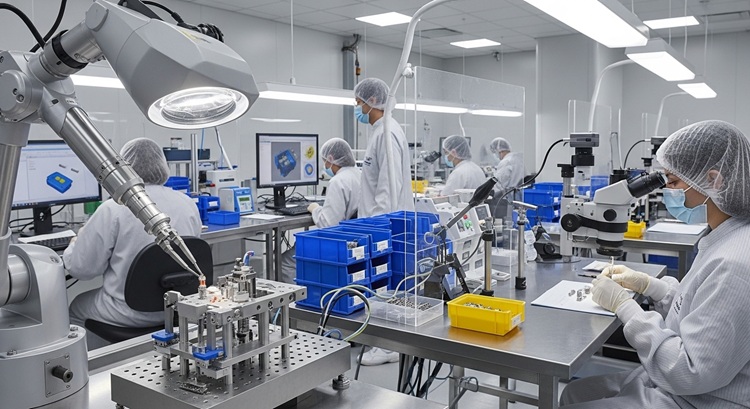
Medical device manufacturing is, at its core, a story about what happens when scientific ambition meets industrial reality. The idea for a device may emerge from a clinician’s frustration, a researcher’s observation, or an engineer’s insight. But the moment that idea is committed to a drawing and handed to a production team, it enters a different world entirely, one governed not by hypothesis but by process capability, regulatory evidence, and the unforgiving logic of scale. How manufacturers navigate that transition, from first prototype to reliable commercial output, determines whether a promising device ever reaches the patients who need it.
Table of Contents
Prototyping: Where Assumptions Get Tested
In the early stages of medical device production, a prototype is less a finished object than an interrogation. It asks whether the geometry a designer specified on screen can actually be produced with the tooling and materials available. It asks whether the tolerances written into a drawing reflect what a process can deliver consistently, or only what it can achieve on a good day with careful attention.
The most instructive prototypes are built using production-representative methods. A component made on a prototype injection mould, using the intended resin, under realistic processing conditions, will reveal the failure modes that matter: the sink marks, the warpage, the short fills that arise from the interaction of design and process. Discovering those problems at this stage is manageable. Discovering them after a process has been validated and a regulatory submission filed is a different matter entirely.
Design for Manufacturability
Between prototype and production sits a discipline that many development programmes underinvest in, and later regret. Design for manufacturability is the systematic evaluation of a device design against the real capabilities of the intended production process, conducted before tooling is cut and before the design history file is locked.
In rigorous medical device manufacturing, this review examines:
Feature geometry
Draft angles, wall thicknesses, and internal radii that govern whether a mould fills completely, ejects cleanly, and holds its dimensions across thousands of cycles
Tolerance stack-up
The accumulated effect of individual component variations on how a multi-part assembly fits and functions under clinical conditions
Material processability
Whether the specified material behaves predictably under production temperatures, pressures, and cycle times, not just in a laboratory setting
Inspection feasibility
Whether critical dimensions can be reliably measured with available equipment at the uncertainty level the design requires
Medical device manufacturing in Singapore has built real capability in this area. Engineers with backgrounds spanning injection moulding, metal injection moulding, and precision machining work alongside development teams to surface and resolve design-process conflicts before they compound into production failures.
Process Validation: The Evidence That Regulators Require
Before any medical device production process can supply product for distribution, it must be validated. Validation is the structured, documented demonstration that a process consistently delivers output meeting its specifications. It is not a single experiment. It is a programme of studies, conducted in sequence, that builds the evidentiary foundation on which regulatory submissions and ongoing quality assurance both depend.
The standard structure follows three stages:
Installation Qualification (IQ)
Verifying that equipment is installed correctly, that utilities meet specifications, and that environmental conditions are as required
Operational Qualification (OQ)
Demonstrating conforming output across the full operating range of process parameters, including conditions at the boundaries of that range
Performance Qualification (PQ)
Confirming consistent process performance under normal production conditions, using production personnel and production-scale equipment over a defined series of runs
What validation produces, beyond the regulatory documentation, is institutional knowledge about how a process actually behaves. That knowledge becomes the reference point for every change control decision that follows.
Scale-Up: Where the Real Challenges Begin
A process that performed well at low volume has a way of revealing new behaviours when production demand increases. Cycle times compress. Shift patterns lengthen. Operator variability, manageable in a small team, becomes a structural variable when a facility runs around the clock. The transition from validated pilot output to full commercial medical device production is where many programmes encounter their most costly surprises.
Managing that transition requires deliberate preparation:
Statistical process control
Real-time monitoring of critical parameters through control charts, enabling detection of process drift before non-conforming product is made
Measurement system analysis
Verification that inspection methods can detect the variation they are designed to monitor, at production throughput rates rather than laboratory pace
Operator qualification
Documented training and competency assessment for every production role, applied consistently across shifts and refreshed when processes change
Supplier alignment
Confirmation that component and material suppliers can scale their own output without process changes that would alter incoming quality
Singapore’s advanced medical manufacturing infrastructure supports this transition with access to certified cleanroom capacity, validated sterilisation services, and a supply network experienced in meeting increased demand within the quality framework that regulated production requires.
Production Readiness as a Scientific Commitment
There is a tendency, in the pressure of a development programme, to treat manufacturing scale-up as a logistical problem rather than a scientific one. The validation data exists. The process is running. Surely volume is just a matter of adding shifts and ordering more material. That assumption has derailed more than a few programmes that looked commercially ready on paper.
Production readiness is, in the end, a form of evidence. It requires the same rigour as clinical validation: structured studies, documented results, and honest assessment of what the data actually shows. The manufacturers who bring that standard to every stage of the journey, from first prototype to full commercial output, are the ones whose products reliably reach the patients who depend on them. That commitment is what Medical device manufacturing demands, and what the best practitioners in the field consistently deliver.